TL;DR
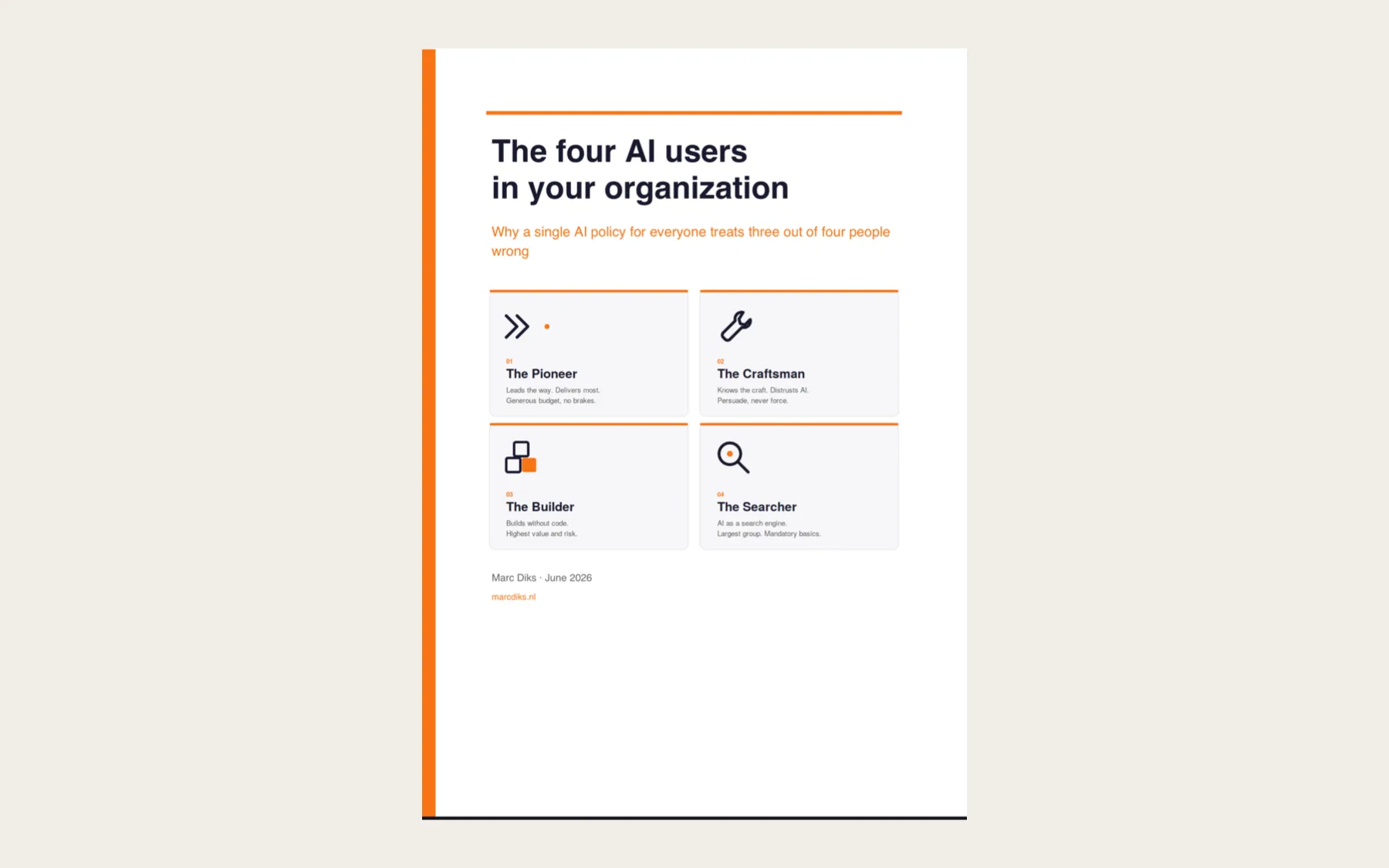
- Every organization has four kinds of AI users: the pioneer, the craftsman, the builder and the searcher.
- They respond in opposite ways to the same levers, so a single AI policy for everyone treats three out of four wrong.
- The question is not how you roll out AI, but which lever (budget, pressure, governance) you turn for each type.
- The full model is in a free whitepaper you can download at the bottom.
In most organizations I speak with, a considered AI policy is still missing. And if there is something, it's one set of rules, one training, one token budget, spread neatly over everyone. Logical, because that's how you do policy. Only with AI it doesn't work, and the reason only became clear to me once I lined up the people instead of the policy.
Because I don't see a homogeneous group of AI users. I see four, and they have surprisingly little in common.
The four types I see everywhere
The first is the pioneer. The developer who runs out ahead, tries every new model, and without hesitation sets three approaches side by side to see which one wins. This person burns the most tokens of anyone, and also delivers the most.
The second is the craftsman. The experienced developer who can still really build, but keeps AI at arm's length. Often someone who learned their craft without AI and sees it as a threat rather than a help. Don't underestimate this group, because these are the people who can still properly judge an AI's output.
The third is the builder. The business user who builds their own tools without a coding background. High speed, close to the business, but also the only type where the highest value and the highest risk sit in the same person.
The fourth is the searcher. They use AI as a better Google: a question in, an answer out, and the occasional email to draft. This is by far the largest group.
Why a single policy fails
When I put these four side by side, something struck me that I could no longer ignore. They respond in opposite ways to exactly the same levers.
Take the token budget. For the pioneer a limit is a brake that costs return directly, because every hour spent requesting budget is an hour not spent on output. For the builder that very same limit is a focus filter that prevents ten hobby projects that never go live.
How to connect budgets and returns for each user type is covered under AI costs and ROI.
Or take pressure. For the searcher a mandatory baseline training does work, because there's no resistance, only unfamiliarity. You fill an empty space. For the craftsman that same requirement backfires, because then you push against a wall called distrust. Two groups that look alike on the surface, both light users, and yet one needs exactly the opposite of the other.
That's the core. Where organizations do make AI policy, they almost always do it as one size for everyone. And that can't be right for all four, because whoever treats everyone the same treats three out of four wrong. Not because the policy is poorly thought out, but because it answers the wrong question. The question is not how you roll out AI. The question is which lever you turn for each type.
Follow me on LinkedIn
The whole model in a whitepaper
I've fully worked out the four types: who they are, how you treat each one to get the most out of them, and the framework with the three levers (budget, pressure, governance) you deliberately set differently per type. Including a matrix that shows at a glance where you're strict and where you give room, and how the groups ideally move towards one another.
It's all in the whitepaper. You can download it below.
 Free whitepaper
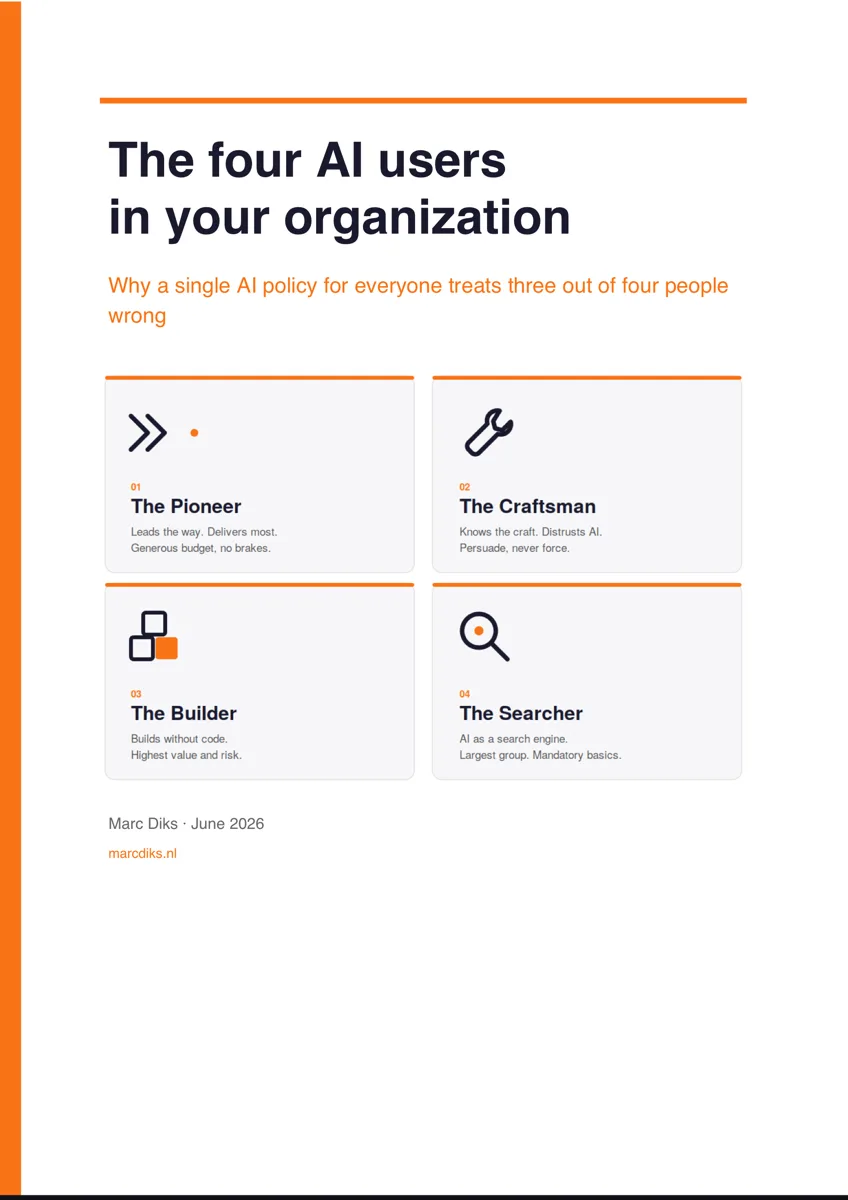
The four AI users in your organization
The four types fully worked out, with the framework of the three levers and a matrix that shows per type where you're strict and where you give room. PDF, 14 pages.
Download the whitepaper (PDF)
Free whitepaper
The four AI users in your organization
The four types fully worked out, with the framework of the three levers and a matrix that shows per type where you're strict and where you give room. PDF, 14 pages.
Download the whitepaper (PDF)