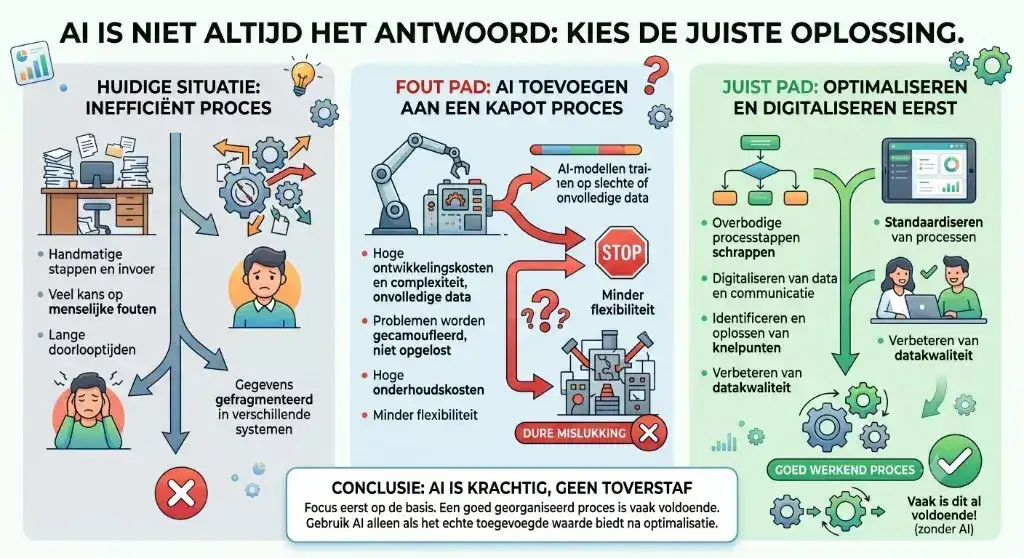
AI enthusiasm has its own gravitational field. Everyone wants in, budgets are loosening and the question is never whether, but when. That's exciting. But it's also exactly why you can't sit back and relax.
TL;DR
- 95% of AI pilots deliver zero P&L impact (MIT Project NANDA, 2025) — not little impact, but zero, and that is the norm, not the exception.
- "What can AI do here?" is the wrong first question. The right one: what is the actual problem, and what's the smartest way to solve it?
- What's missing is the helicopter view: someone who steps back and dares to ask whether the question itself is right.
- Pushing back is not obstruction. It's asking the question that rarely gets asked in the rush of a project.
- 42% of companies abandoned AI initiatives in 2025 — not because of bad technology, but because they were answering the wrong question.
The numbers don't lie. MIT Project NANDA published in July 2025 (opens in new window) that 95% of organisations deploying generative AI saw zero measurable P&L impact — not little impact, but zero — and Gartner states that 85% of all AI projects fail (opens in new window) due to poor data quality or a lack of relevant data. These aren't edge cases at the tail end of statistics; this is simply the norm that most organisations find themselves in.
And the reason is always the same: technology doesn't fail — the approach does. Organisations start with the tool instead of the problem, asking "what can AI do here?" when the question that actually matters is: what is the problem here, and what's the smartest way to solve it?
How Do You Choose Between AI or No AI?
What I see in practice is that a specific role is missing — not the developer, the project manager, or the AI specialist in the classical sense, but someone who steps back, looks at the situation from a distance and dares to say: wait a moment, is the question itself right?
That sounds simple, but it isn't. That person needs to be technical enough to understand what AI can and can't do, process-savvy enough to see where the real bottlenecks are, and communicative enough to translate that back to the people making the decisions.
In large organisations this role is sometimes called solution architect or business analyst, but in most SMEs it doesn't exist formally, so that step gets skipped — not out of bad will, but simply because nobody is responsible for it.
Lean People described it aptly in October 2025 (opens in new window): many organisations digitalise the mistakes that were already there, because they never took the step to optimise first. The same applies to AI: you can't build intelligence on a foundation that doesn't work.
Follow me on LinkedIn
Asking the question behind the question
What does this look like in practice? It starts with one simple intervention: before you build or buy anything, you take twenty minutes to question the question itself.
Someone asks: "can we use AI for credit assessment?" The question behind the question is: what does the current process look like, where's the delay, what isn't standardised, and which input is unstructured and why?
I've done this kind of analysis several times and what you find is almost always the same: the process has eight steps, three of which are entirely manual, because nobody ever took the trouble to write down the rules that live in someone's head. The credit rules are not data but knowledge, and knowledge that lives in someone's head cannot be automated, let alone made more intelligent — the only thing AI does in that situation is accelerate the ambiguity.
Only once you've answered those questions do you know whether AI is the smartest intervention, or whether you should actually rebuild your application form and capture your credit rules as data rather than as knowledge that only exists in certain people's minds.
In many cases the answer is: start by digitalising and standardising — not as preparation for AI later, but because that alone is enough to make major progress.
And that's exactly why I push back when someone asks whether we can "do something with AI." Not because AI doesn't work, but because that question is too early.
Pushing back is not obstruction
I want to clear up one misconception: pushing back on an AI proposal is not the same as saying AI has no value. I firmly believe in what AI can do, and I build with it myself every day.
But there is an essential difference between deploying AI because it's the smartest solution for a clearly defined problem, and deploying AI because it has momentum and you want to feel like you're part of something. The first delivers results, and the second delivers a pilot that's quietly buried after six months because nobody can quite explain what it produced.
I recognise that pattern in almost every conversation I have about this — with directors and entrepreneurs who say: "yes, that's exactly what happened with us." They didn't see it coming because the dynamic feels so logical: the business wants something, technology offers a solution, everyone is enthusiastic, so the train moves — while nobody in that triangle has the formal task of saying: wait, let's first understand what we actually need.
What's missing is someone who dares to resist popular advice, and that's ultimately what pushing back on an AI proposal means: not obstruction, but asking the question that rarely gets asked in the rush of a project. It's easier to go along, start a pilot, and see what it produces, because that feels constructive and modern and causes no friction — until the pilot produces nothing after six months and nobody can explain why.
S&P Global Market Intelligence found in 2025 (opens in new window) that 42% of companies had abandoned their AI initiatives that year, up from 17% the year before — and those aren't failures due to bad technology, but due to an approach that answers the wrong question.
The business case behind that question starts with AI costs and ROI.
Next time you hear someone say "we need to do something with AI," ask one question back: what is the problem we're trying to solve? If the answer is vague, you already have your answer — AI is not an answer but a tool, and a tool only has value when you know what you're using it for.