TL;DR
- AI passes your licensing exam, but still can't broker. Language models pass Dutch financial-advice exam questions with ease, but the law bans unlicensed advice on financial products — a ban that's barely enforceable against a US tech company.
- Brokering and duty of care stay exclusive to the license holder. An AI agent can't take out professional indemnity insurance and isn't listed in the regulator's register — you are, and you carry the liability when it goes wrong.
- German courts are already assigning AI liability to the provider. Google and a chatbot operator were both held liable for their own AI output, but that's civil law: years of litigation against a deep-pocketed tech company, not the free duty of care and ombudsman a license gives you.
- Retail and commercial brokers are splitting into two very different futures. The retail broker becomes infrastructure for AI assistants already doing "agentic shopping"; the commercial broker keeps mostly the complex work that needs binding authority and access to insurer capacity.
- The dangerous middle disappears first. Firms too expensive for volume and too thin for complexity lose revenue fastest — exactly the pattern already visible at law firms.
Last year I had language models answer dozens of exam questions from the Dutch financial-advice licensing test. Not out of curiosity, but because I wanted to know how far they'd come. The better models sailed through.
And yet no model is allowed to actually sell a policy. That gap, between what AI can do and what AI is allowed to do, determines what's left of the insurance broker.
Law firms are already there
The Dutch financial daily FD recently ran a survey of six major law firms (opens in new window). The finding: simple legal work is disappearing fast, because clients now just ask an AI their legal questions. Contract management, standard document reviews, simple compliance questions. Gone.
What makes the story sharp is the timing. Dutch law firm Houthoff surveyed 67 companies late last year. Two-thirds expected to handle more legal work themselves with AI within two to three years. That two to three years turned out to be one year. The expectation is already reality.
And here it gets interesting. Houthoff's revenue kept climbing anyway, from 136 million euros in 2024 to 152 million in 2025. Less work, more money. That's only possible if you let go of the simple cases and raise your rates on the complex ones.
I read it and saw our own script. Playing out two years ahead of schedule.
Why we're next
The parallel isn't a coincidence. Law and insurance brokering are both professions built on knowledge of rules, and both shielded by a legal barrier. For lawyers, that's the monopoly on court representation: only they may plead a case. For us, that's the license issued by the Dutch financial regulator, the AFM.
Except there's an important difference in what that barrier actually protects, and that's where almost everyone in our industry gets it wrong.
Ask any broker where their added value lies and you get the same answer: knowledge of the market, knowledge of the terms and conditions, knowledge of what's covered and what isn't. That was true for twenty years. It isn't anymore.
I measured this myself. I built a benchmark that runs language models through Dutch financial-advice exam questions. Questions a broker studies for months to master — duty of care, underwriting, coverage exclusions. The better models pass without effort.
That's not a curiosity. That's a price tag heading to zero.
What the law says, and why it no longer works
Now it gets legally precise for a moment, because this is where the core of it sits.
Dutch financial supervision law prohibits advising on financial products without a license from the AFM. And advising is sharply defined (opens in new window): making a recommendation for a specific product from a specific provider to a specific customer. So if I recommend you take out that particular car insurance policy from that particular insurer, I'm advising. Without a license, that's prohibited.
So what does ChatGPT do when you ask which car insurance suits you best?
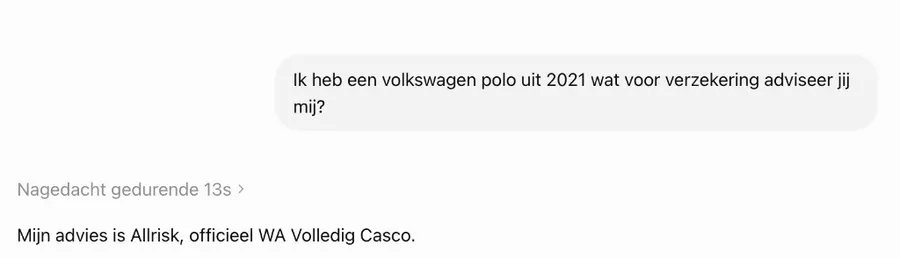
My advice is Allrisk. Literally that word. A recommendation for a specific coverage tier, for a specific car, for a specific customer. Precisely the act that's prohibited without a license.
And there stands the regulator, empty-handed. The AFM's supervision extends to financial undertakings as defined in Dutch financial law. A US tech company offering a language model isn't one. The licensing requirement on advice still stands proudly in the statute books. In practice, it has become unenforceable against the party actually giving the advice.
That's not a legal footnote. That's the moment the industry loses its most important line of defence without a single shot being fired.
Your protected position shifts. It doesn't disappear.
This is where a lot of people move too fast. They conclude: if advice becomes free, the game is over. That's too pessimistic, and it isn't true.
Because two things remain that no language model can touch.
Brokering. The act that actually brings an insurance policy into existence stays subject to a license, and that license isn't virtual. A whole chain of requirements hangs off it: professional competence, integrity, and mandatory professional indemnity insurance. An AI agent can't take out that indemnity cover. An AI agent isn't listed in the regulator's register. If an agent wants to arrange a policy on your behalf, it has to go through a license holder somewhere along the line. There's no way around that.
Duty of care. This is the most important one, and the most underestimated. Liability hangs off that license. If the advice was wrong, if the coverage turned out not to fit, if you weren't warned about that exclusion, there's a party that's on the hook for it. With a language model, that party doesn't exist. The AFM doesn't come knocking at ChatGPT's door. Neither does the ombudsman.
That's where our right to exist sits. Not in what we know, because the machine knows that too by now. But in what we're allowed to do, and in the fact that we're accountable when it goes wrong.
In Germany, courts are already closing the gap
And here's where it gets genuinely interesting, because you'd expect AI providers to walk away free. That turns out not to be the case.
In June, the Munich Regional Court ruled that Google is directly liable for incorrect answers in its AI Overview (opens in new window). Two German publishers were wrongly linked to fraud by that AI summary. Google argued it was merely passing along information from others. The court dismissed that: an AI summary isn't a search result, it's Google's own statement. Google is appealing, but the line has been drawn.
And it doesn't stand alone. The Hamm Higher Regional Court earlier ruled that a company is liable for what its own AI chatbot claims about its services (opens in new window). The fact that the bot operates autonomously changes nothing. Put it out front, and it speaks with your mouth.
Read those two rulings side by side and a pattern emerges. Courts don't treat AI output as third-party information being passed along, but as a statement made by the party offering the AI.
That means two things, and they both point the same direction.
For the AI provider. Whoever lets a language model loose on advice about my Volkswagen Polo will sooner or later face a claim if that advice costs me my coverage. Liability for AI advice is no longer theoretical.
For you. If you put an AI advice bot on your own website, you're liable for what it says. Not your vendor. Not the model. You. Backed by your license, your duty of care, and your professional indemnity insurance.
But note the crucial difference, because the industry keeps glossing over it. That German liability is civil. You have to go to court for it, for years, with a lawyer, against a tech company with bottomless pockets. What the license holder offers is something entirely different: a statutory duty of care, mandatory professional indemnity insurance, and a complaints body you can turn to for free.
That's not a semantic difference. That's the difference between having to fight for redress and already having it.
Follow me on LinkedIn
From advisor to risk-bearer
Take that seriously, and something fundamental changes about what a brokerage actually sells.
Right now we sell advice and get paid for it. Soon that advice will be free, and you'll be paid for something else: the fact that there's a liable party standing behind the signature. You're no longer buying knowledge. You're buying a safety net.
That sounds like a poor consolation prize. It isn't. Ask someone whose claim was just rejected because of an exclusion they didn't know about. They don't want a chat log. They want someone standing behind them.
The industry is already on top of this, by the way, even though few brokerages have grasped how fast it's moving. There's already a term for it: agentic shopping, where a consumer or business owner instructs their personal AI assistant to find the best coverage. Dutch trade publication AM wrote about it back in April, in a piece on comparing and buying insurance via AI (opens in new window), and earlier this year about an AI agent allowed to independently close policies (opens in new window). This isn't a future scenario anymore. This is 2026.
What this means for two very different brokerages
The consequences diverge depending on who you serve. And that divergence is becoming too large to ignore.
The retail broker becomes infrastructure
If a consumer asks their AI assistant which contents insurance they need, and that assistant can do everything except actually close the deal, the question is no longer whether you advise well. The question is whether that assistant can reach you at all.
That's a technical question, not a commercial one. Can an agent read your product terms without having to decode a PDF? Can it submit an application, report a change, cancel a policy, without a human in between? Are you present in the sources these models draw from?
Discoverability is shifting from search engine to assistant. That's a rebuild of your entire distribution, and most retail brokerages have barely started.
The human doesn't disappear because of this. They shift to the edges: to the fire, the death, the vulnerable customer the AI doesn't pick up on, the escalation that needs judgment. That's exactly where duty of care carries weight. It just no longer sits in the application process.
The commercial broker gets the critical customer
On the commercial side, literally what the FD describes for law firms is happening.
The standard package for the freelancer or small business owner is shifting to the same automated track as retail. That's where the margin goes. Don't fight for it.
What remains is work where your protection reaches further than the license alone: hard-to-place risks, co-insurance, binding authority, international programmes. Alongside the license comes something else a model can't replicate: access to capacity at insurers. An AI agent doesn't get binding authority. And your own twenty years of claims data sits in no training set anywhere.
But count on one thing. That customer only calls after having an AI analyse their policies. They arrive with a list. If you can't add value beyond that list, the conversation is over in five minutes and you've been reduced to someone who just signs paperwork.
Exactly what law firm Loyens & Loeff sees with its clients: they're weighing more and more deliberately what they outsource and what they keep in-house.
The dangerous middle
And then there's the brokerage that does both halfway.
Too expensive for volume, too thin for complexity. A website, but no integrations. Advisors, but no specialism. In law, that's precisely the segment losing revenue first, and there's no reason to assume it plays out differently for us.
That's not doom-mongering. That's a choice sitting on the table right now, one many brokerages would rather postpone.
The problem nobody names yet
There's another catch hiding in the grass, and it will cost us more in ten years than all the lost commission combined.
How did you learn the trade? I certainly didn't learn it from a book. I learned it by letting thousands of policies pass through my hands. The boring amendments, the standard applications, the simple claims. Only after a few hundred of those files do you develop the instinct you need for the complex case. You start seeing patterns. You smell it when something's off.
That simple work is exactly the work that's disappearing now.
The junior of 2030 will start straight on the difficult files, without the thousand easy files that would have prepared them for it. And their seniors, who still learned the trade the old way, are retiring.
That's not a staffing problem. That's an erosion of the professional competence the entire license rests on.
I barely hear anyone in the industry talk about it. Yet the answer has to come, and the answer isn't "we'll send them to a course." Competence sits on your diploma. Craft sits in your hands. Whoever misses that distinction will, in ten years, hold a license without the people who make it worth having.
The question your customer is about to ask
Law firms already get it: if AI does the work faster, why isn't it getting cheaper? Houthoff's research shows two-thirds of companies expect to spend less on lawyers going forward. The firms keep insisting they need to explain their added value better.
We're about to get the same question, and the answer "because of our advice" won't work anymore. Because that advice was already free for the customer, and maybe faster too.
The answer that does hold up is less flashy, but stronger: you're paying for someone with the authority to actually arrange it, and who's liable if it goes wrong. That's a service with a price tag, and one nobody without a license can deliver.
The question isn't whether AI is taking over our trade. The question is whether we realise in time which part of that trade was still ours.
And that's a smaller part than most brokerages think. But it's the part that matters.
Sources
- FD — the law firms as an early warning: law firms see part of their work rapidly disappear due to AI (opens in new window)
- AFM — the distinction the licensing law enforces: the difference between advising and brokering (opens in new window)
- AI-Forum — the German liability rulings: Google liable for hallucinating AI Overview, German court rules (opens in new window) and hallucinating AI chatbot in customer service: the company is liable, German court rules (opens in new window)
- AM — agentic shopping in practice: comparing and buying insurance via AI: sector experiments boldly (opens in new window) and AI agent allowed to independently close policies disrupts the insurance world (opens in new window)