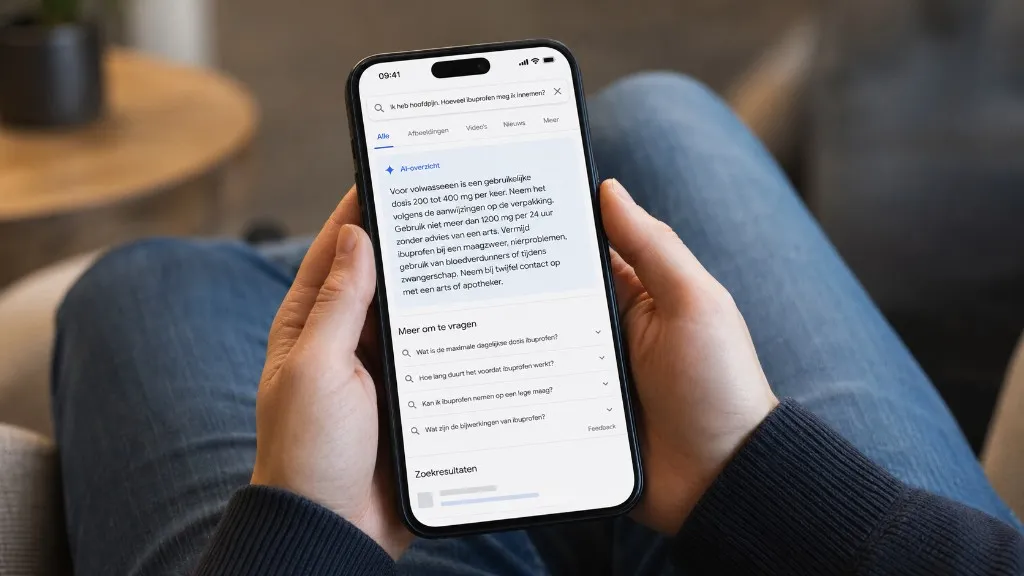
A German court held Google liable for false AI answers. That sounds like a legal story. I think it hits your search traffic.
An AI Overview isn't an ordinary search result, but a Google-generated summary that makes its own new statements based on multiple sources. That's exactly why the ruling matters for SEO professionals, site owners, lawyers and anyone dealing with sensitive questions in health, law or insurance: if such an AI answer is factually wrong, it isn't only about reputational damage, but also about liability, cost and shifting web traffic.
Last year I watched informational search traffic on one of my sites drop 30 to 40 percent over twelve months. Rankings held up, the content was accurate, and the counter kept falling anyway. The cause wasn't on my site. It sat at the top of the search results, in the AI answer Google gave my visitors before they ever needed to click.
Everyone in search engine optimisation (SEO) treats that decline as a one-way street. Zero-click is here to stay, and informational traffic isn't coming back. I believed that too. Until a German court issued a ruling in late May that made me start doing the math.
TL;DR
- Google has been held liable. The Landgericht München I ruled on 28 May 2026 that Google is directly liable for incorrect AI Overviews — no longer a neutral intermediary, but the direct source of the content.
- Not a final ruling yet. It's a preliminary injunction, Google is appealing, and the Landgericht Berlin ruled the opposite way in a parallel case.
- YMYL is the breaking point. If the liability line holds, a wrong AI answer on a medical, legal or insurance question becomes a real cost for Google.
- Google has already pulled AI answers before. On medical queries and in e-commerce, Google already dialled back AI Overview coverage once it got risky or costly.
- My hypothesis, not yet proven. On risky YMYL queries, search traffic may partly return. I'm going to measure it over the coming months with nine queries across three industries.
What the German court actually said
Two publishers from Munich took Google to court. In Google's AI Overview, they were linked to fraud, subscription traps and dubious business practices for certain search queries. The problem: those links didn't exist. The AI had blended information about entirely different, genuinely dubious companies with the publishers' names, inventing a story that appeared in no source at all.
On 28 May 2026, the Landgericht München I (opens in new window) sided with the publishers. The core of the ruling: with an AI Overview, Google is no longer a neutral intermediary but the direct source of the content. The court calls Google an "unmittelbarer Störer" — a direct originator. Why? Because the AI doesn't display search results, but makes independent, new statements based on its own synthesis of multiple sources. Google argued that users can check the sources themselves. The court dismissed that. An AI answer is self-contained and understandable on its own. And the fact that the error could later be discovered, even when links or source references are shown alongside, doesn't remove responsibility for the original statement.
Now for the nuance, because it matters. This is a preliminary injunction, not a final ruling, and Google is appealing (opens in new window). The company calls it "specific and limited errors, not the fundamental way AI Overviews display web content." And there's a counter-signal. The Landgericht Berlin ruled in a parallel case that AI Overviews are not independent content at all, and applied the classic search engine exemption instead. The legal question is therefore far from settled. It will almost certainly move to higher courts, up to the Bundesgerichtshof or the European Court of Justice. Anyone claiming the case is closed is moving too fast.
Why this hits the search product, not just reputation
Most coverage I read treated this as a defamation and reputation-damage story. Fair enough, but it misses the bigger consequence. If Google is liable for what its AI claims, every AI answer becomes a potential cost item. And costs change behaviour.
Consider where it really hurts. A wrong AI answer about a shop's opening hours is annoying. A wrong AI answer about a medication dosage, a notice period, or your insurance coverage can cause someone real harm. That exact type of question falls under what Google itself calls YMYL, short for Your Money or Your Life — topics that directly affect your health, your money or your wellbeing. That's precisely where a wrong answer has real consequences. Google already applies its strictest quality standards there in its own guidelines. The German ruling adds a new pressure on top: not just quality pressure, but liability pressure.
The idea that European law can reshape Google's product isn't theoretical, by the way. It has happened before. After the European Court's right-to-be-forgotten ruling in 2014, Google had to build an entire removal mechanism so people could get search results about themselves taken down — a system that now handles millions of requests. And the French privacy regulator fined Google fifty million euros under the GDPR. Europe doesn't push Google with a polite request. It pushes with rules and liability, and that changes what the product looks like.
YMYL: why medical, legal and insurance are the most exposed
Let me make it concrete with my own world: insurance. In the entire AI Overview debate, the conversation is about news, about publishers, sometimes about health. Insurance barely comes up, even though it's a textbook example of YMYL. Someone searching "am I covered for water damage" or "do I need liability insurance" is increasingly shown an AI answer at the top. If that answer is wrong, and someone bases a decision on it, the harm isn't hypothetical.
And then there's a number that keeps nagging at me. AI startup Oumi ran an analysis commissioned by the New York Times, cited by The Decoder (opens in new window). Google's AI Overviews, running on the Gemini 3 model, answered correctly on a standard benchmark roughly 91 percent of the time. That sounds reassuring. But look at the second number: of those correct answers, more than half — 56 percent — could not be traced back to the sources Google itself linked. Google disputes the study's methodology, so treat it as an indication, not an established fact. Still, it cuts to the heart of the matter. The AI makes statements that appear in no source at all, even when the answer happens to be right. That's exactly what the German court caught.
And at Google's scale, even a small error rate adds up hard. At its own developer conference, Google reported that AI Overview has 2.5 billion monthly users (opens in new window). Do the math on what a few percent wrong means at that scale. Millions of incorrect answers, every hour, again and again. On harmless questions, that's noise. On YMYL questions, it's a liability machine.
Follow me on LinkedIn
Google has already done this, and nobody connected the dots
Now for the part that lifts my hypothesis from speculation to pattern. Google has already shown exactly the behaviour I'm predicting. More than once.
In January 2026, Google pulled AI Overviews for certain medical search queries. The trigger was a Guardian investigation, reported by TechCrunch (opens in new window), which showed that the AI summaries gave misleading and sometimes outright dangerous health information — think wrong reference values for blood tests, or advice to cancer patients to do something doctors flagged as dangerously wrong. Google removed AI Overviews for part of those queries. Not out of kindness, but under pressure.
And the pattern is broader. A long-running tracking study by BrightEdge, summarised by Omnibound (opens in new window), found that Google deliberately reduced AI Overview coverage in e-commerce from 29 percent to 4 percent. The reason there was commercial: purchase-intent queries are where ad revenue lives, and Google wants to protect that. Treat the exact percentages as indicative, since they come via a secondary source, but the direction is clear. Google steers AI Overview coverage by industry, deliberately and actively.
That's proof the lever exists, and that Google is willing to pull it. So far it has mostly pulled the lever where money was at stake. The question is whether liability becomes the second lever.
My hypothesis, and why I'm not certain
Here's my claim, without dressing it up. Until now, Google actually let AI Overviews flood the riskiest YMYL queries. Medical and legal search queries have the highest coverage of all, because the information is easy to summarise and the ad incentive is low. Google had no commercial reason to hold back. The German ruling now adds a non-commercial reason: liability. If that cost item becomes heavy enough, Google's calculation could tip, and it dials back AI Overviews on exactly the queries where mistakes start costing money. And when the AI summary disappears, the ten blue links reappear. That's when part of the search traffic to websites in those industries comes back.
Now for the honesty, because I'm not selling you certainty. There are three good reasons to doubt this.
First: one German court doesn't change the global product policy of an American giant overnight. Google is appealing, and the opposing ruling from Berlin shows that even German courts disagree with each other.
Second: I can't fully attribute my own 30-to-40-percent drop to AI Overviews. Other factors always play a role, from Google core updates to shifting search behaviour. Zero-click is the most likely primary cause, but I'm presenting that as reasoned attribution, not proof. For perspective: an analysis by Graphite and Similarweb across 40,000 top sites, summarised by WoodWing (opens in new window), found that organic traffic dropped only a few percent on average. The heaviest hits land on informational content, and that's exactly where my site sat. My 30 to 40 percent isn't an average, then — it's the sharp edge of a very unevenly distributed effect.
Third: Google's earlier pullbacks were commercially driven, not legally driven. It's a bet that liability presses the same lever that ad revenue did.
That makes this a hypothesis, not a prediction. And with a hypothesis, there's only one sensible thing to do.
So I'm going to measure it
I'm not going to guess, and I'm not going to wait for some guru to tell me how it works. I'm going to track it.
I've picked nine search queries, three per industry, all with informational intent and all YMYL — measured in Dutch, since that's my market. For medical, for example, "hoeveel ibuprofen mag ik per dag" (how much ibuprofen can I take per day); for legal, "opzegtermijn huurcontract particulier" (notice period for a private rental contract); for insurance, "eigen risico zorgverzekering 2026" (health insurance deductible 2026). Over the coming weeks and months, I'll check for each query whether Google shows an AI Overview, or whether plain links appear again. Same conditions every time: incognito, logged out, Netherlands, fixed times. A single measurement means nothing, since AI Overviews vary by session. The trend over time means everything.
If the share of AI Overviews on these YMYL queries drops, that's a first signal my hypothesis holds and that search traffic in those industries can come back. If it stays flat, I've learned something else: that liability doesn't tip Google's calculation, at least not yet. Both outcomes are worth having. That's the difference between an opinion and a measurement.
Last year I wrote that AI Overviews are eating your traffic, and that story still holds. What's been added since is the first serious reason to think it can spring back in some corners of the web. Not everywhere. Not guaranteed. But on the queries where a wrong answer can cost Google money, the calculation is shifting. I'll know more in a few weeks. I'll share the numbers then.
Sources
- Landgericht München I ruling, 28 May 2026, via heise online (opens in new window)
- Google is appealing, via IEX/Reuters (opens in new window)
- Dutch legal analysis, AI-Forum (opens in new window)
- Oumi/NYT analysis and Google's scale, The Decoder (opens in new window)
- Google's AI Overview user numbers, ComputerBase (opens in new window)
- Google pulls medical AI Overviews, TechCrunch (opens in new window)
- AI Overview coverage by industry, Omnibound (opens in new window)
- Counterpoint: limited average effect across 40,000 sites, Graphite/Similarweb via WoodWing (opens in new window)