Most AI tools are a layer on top of someone else's model. That works fine — until the meter underneath starts running and you can't get out.
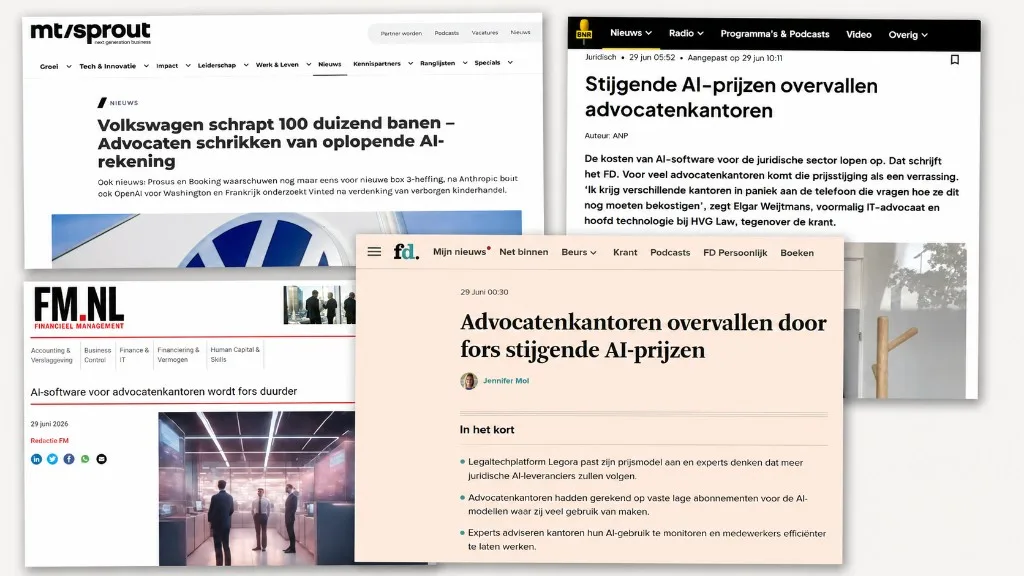
On 23 June 2026, Legora, an AI platform for law firms, overhauled its pricing model. No more flat fee per user — it switched to pay-per-use. Bills can now climb sharply.
I saw the news go by. This is not an incident. It is the first of a long series of invoices that will land at many more companies, including small and medium-sized businesses.
TL;DR
- Almost every "AI tool" is a wrapper. Software on top of a model from OpenAI, Anthropic or Google — the real costs arise at the model underneath, not at the builder of the layer.
- Flat fees don't hold. When usage rises or the model gets more expensive, your bill rises with it. Legora and Cursor prove this is already happening.
- Getting out costs more than you think. Switching means losing your settings, integrations and your team's familiarity; a cheaper model often delivers noticeably lower quality.
- Four questions give you leverage. Ask which model runs underneath, how you're priced now and in the future, what happens when their costs rise, and whether you can take your data with you.
What you're actually buying when you buy "AI"
You've had an AI tool in your business for a few months now. One that writes copy, handles customer questions or reviews your proposals. You pay a monthly fee, it works, you're happy.
But do you know exactly what you're paying for?
In most cases, you're not buying AI. You're buying a layer around it. The model that does the actual thinking comes from someone else — usually OpenAI, Anthropic or Google. The tool you use forwards your question to that model, gets a response back, and presents it neatly in an interface built for your line of work.
That layer has a name. In the market it's called a wrapper. And once you realise you're using one, you'll start looking at your monthly fee very differently.
What a wrapper actually is
An AI wrapper is a software product built on top of an existing AI model from an external provider, where the value lies in the interface, the instructions and the workflow — not in a proprietary model. The maker doesn't train AI themselves. They rent the thinking from a large provider and pay for each small chunk of text processed.
That sounds technical, but you know the examples. A writing assistant that uses ChatGPT under the hood. A customer service chatbot running on Claude. A marketing tool with a "write with AI" button. Almost all of them are wrappers.
And then there's a second form that gets overlooked even more often. The AI feature in software you've had for years. The summarise button in your notes app, the assistant in your CRM, the smart suggestions in your accounting package. Those are wrappers too — just built into a product you never thought of as an "AI tool."
The result is that many business owners are locked into an AI model in two different ways without realising it. Not because they did anything wrong. Because nobody explained it to them.
Where wrappers work brilliantly
Now the part you might not expect from a vibe-coder: a wrapper is often an excellent choice.
I build these layers myself. And precisely because of that, I know how much work goes into a good wrapper. The interface that stays out of your way. The instructions to the model that finally give the right answer after a hundred rounds of testing. The connection to your systems. The maintenance every time the underlying model changes.
For most SMEs, doing all of that yourself is pointless. You buy a finished product, you don't have to build anything, and you're up and running within a day. That's not a second-rate solution. That's simply the smart route.
The hype loves to say you can build everything yourself these days. And that's true, to a point. But "being able to build" and "wanting to maintain" are two different things, and almost everyone forgets the second one. Buying a wrapper means outsourcing that maintenance to someone else. Nothing wrong with that. You just need to know you're doing it — and what it makes you vulnerable to.
The catch: you don't set the price
This is where it gets interesting. And this is the risk almost nobody names.
The wrapper maker pays the underlying model per token. A token is a small piece of text the model reads or returns. The more intensively you use the tool, the more tokens flow through the model, and the higher the costs for the maker.
For a long time, makers solved this with a flat monthly fee per user. Predictable for you, manageable for them. But that model is cracking. Unlike regular software, AI doesn't get cheaper the more you use it. It requires fresh computing power every single time, and for large or complex tasks the cost adds up fast. According to BetterCloud (opens in new window), this is precisely why AI software is mass-migrating to usage-based pricing: flat fees can't hold once a product runs on tokens.
For the broader framework, from consumption to returns, see control of AI costs and ROI.
The Legora story is the first visible proof of that. The Financieel Dagblad (opens in new window) spoke to law firms calling in a panic about their AI bills. According to legaltech expert Douwe Groenevelt in the same piece, firms are now paying around €100 to €300 per user per month, with AI costs potentially running two to three times higher for those who want to keep using the best models.
And it hasn't stayed with lawyers. The coding tool Cursor quietly changed its pricing last year, from a fixed number of requests to usage-based billing. A widely shared thread (opens in new window) described a team whose $7,000 annual subscription was used up in a single day of normal work. Cursor's CEO publicly apologised — but the pricing model stayed.
This is not a Legora problem or a Cursor problem. It's the economics of AI software becoming visible. I wrote earlier that AI costs are not a bubble but a bill. This is where that bill comes from.
Follow me on LinkedIn
Why you can't just walk away
Say your bill doubles. The logical response: switch to a cheaper model. If only it were that simple.
Inside most wrappers, you can't do that yourself. You don't decide which model runs underneath — the tool maker does. Sometimes you technically can't switch because the entire tool was built around one model, with instructions and integrations that don't work anywhere else. And if switching is even possible, a cheaper model often delivers noticeably lower quality for your specific task.
That's the real risk. You're locked into a layer whose price you don't control and whose foundation you don't choose. If the model's price rises, or the maker decides to protect their margin, you pay for it. Walking away costs you your settings, your integrations and your whole team's familiarity.
This is the same dependency I described earlier when writing about AI vendor lock-in and the kill switch. Only here it sits one layer deeper — which is exactly why you don't see it. You think you're buying a tool. You're actually buying a pass-through to a model you don't control.
Building yourself? Then you're buying maintenance
Then the question I almost always get: can't I just build this myself?
Technically: often yes. With today's AI tools, even a non-developer can build their own small layer that talks directly to the model in a few evenings, with no intermediary. I do it constantly. Over the past months I've built more tools of my own than I ever thought possible — without a team and without a development budget. And the beauty of that is you get to choose which model runs underneath, so you can switch to a cheaper or better model whenever you like.
But then you've bought something different. Not a subscription — maintenance.
Because the model changes. The connection breaks. An update wipes out your instructions, or there's an outage at the exact moment your client needs an answer. With a wrapper, that's the vendor's problem. With your own build, you are the vendor. That costs time, attention and a minimum of technical knowledge — every week, indefinitely. I wrote earlier about software on demand and how easy it's become to bring something into existence. Building is no longer the problem. Keeping it running is.
Buying a wrapper is not laziness. Building your own is not heroism. It's a trade-off between a predictable bill that may rise, and maintenance that costs time and expertise. For some business owners the first wins, for others the second. What doesn't work is making the choice without knowing you're making it.
The questions to ask your vendor
You don't have to build anything for this. You just need to know what you're buying. Next time you buy or renew an AI tool, put these four questions to your vendor.
1. Which model runs underneath?
An honest vendor will simply tell you whether they run on OpenAI, Anthropic, Google or something else. Anyone who avoids the question is giving you a hint about how much control you actually have.
2. How am I priced — now and in the future?
Are you paying a flat fee, pay-per-use, or a combination? And more importantly: can that change? Ask whether there's a cap on your monthly costs, so a busy month doesn't catch you off guard.
3. What happens if your costs rise?
The maker pays per token themselves. Ask what happens to your price if the underlying model gets more expensive. The answer tells you whether you have a partner or a pass-through.
4. Can I take my data and my work with me?
If you want to leave in a year, will you get your data, your settings and your history back? A vendor who makes it easy to leave has confidence you'll stay.
Four questions, five minutes. Enough to know whether you're buying a tool or a dependency.
Back to those law firms
The firms calling in a panic right now haven't done anything wrong. They bought a good tool at a flat price and assumed that price would hold. Exactly what you and I would do.
The difference isn't how smart you are. It's whether you know what's running under the hood. The AI bill is coming regardless. The question is whether you'll be surprised when it arrives, or whether you saw it coming.
Frequently asked questions
What is an AI wrapper?
An AI wrapper is a software product built on top of an existing AI model from an external provider such as OpenAI, Anthropic or Google. The maker doesn't train their own model, but builds an interface, instructions and workflow around it suited to a specific task or industry.
Is a wrapper worse than building your own?
No. For most business owners a wrapper is the smart choice, because you buy a finished product and outsource the maintenance. Building your own gives you more control over model and price, but you take on management and upkeep in return.
How do I know if my tool is a wrapper?
Ask the vendor which AI model it runs on. If the company doesn't build its own model, you are almost certainly using a wrapper. Also watch for AI features in software you already had, such as a summarise or write button. Those are wrappers too.
Why are AI tool prices rising?
Because the makers pay for the underlying model per unit of use, and that usage grows as AI is used more intensively. Unlike regular software, AI does not get cheaper the more you use it. That is why more providers are switching from flat fees to usage-based pricing.
Sources
- Law firms caught off guard by sharply rising AI prices (opens in new window) (Jennifer Mol, Financieel Dagblad, 29 June 2026).
- Why AI software is mass-migrating to usage-based pricing: BetterCloud (opens in new window)
- The full timeline of Cursor's pricing change and user reactions: WeAreFounders (opens in new window)