On 12 June 2026, Anthropic received a letter from the US government. At 5:21 PM. With the instruction to shut down its two most powerful AI models immediately. For all customers. Worldwide. Within a few hours.
And it happened.
Imagine your customer service ran on such a model. Or your claims processing. Or your entire document workflow. Your business process would have stopped that day, for reasons having nothing to do with you, at a moment you couldn't have foreseen.
Every specialist will immediately counter: switching models hasn't been a problem for a long time. And that's true. Modern tooling is built so you can swap one model for another with a small configuration change. Anyone working cleanly with an abstraction layer isn't locked into any single provider. In theory, you can migrate a failed model to an alternative in an afternoon.
In theory. Because the problem doesn't arise in the switching itself. It arises when the functioning of your process has become dependent on that one specific model. A prompt that's been fine-tuned for months on the quirks of exactly that model. A workflow that leans on a capability that model did just slightly better than the rest. An output whose quality has silently been calibrated to that level. Then another model can be technically substituted in minutes, but your process suddenly performs worse — and you only find out once it's already running. Switching is possible, but it isn't free.
That is the real lesson of the decision. Not that you're locked into a vendor, but that dependency creeps up on you. You only notice when the plug gets pulled.
That decision is the sharpest of three developments converging these months, together forcing a single conclusion. Open source AI is no longer a technical preference for enthusiasts. It's a governance insurance policy. The costs of proprietary AI are about to rise structurally. A government has shown it can shut down a commercial model overnight. And the hardware to run models yourself has become affordable for ordinary businesses.
Three developments, one thread: whoever hands over full control of their AI also gives away more than they realise.
TL;DR
- A government shut down a commercial AI model. On 12 June, the US government forced Anthropic to shut down its two best models for all customers worldwide within hours. If your process runs on a single model, it can simply stop.
- Switching is easy; dependency creeps. Modern tooling makes switching models technically simple. But once your operation has been fine-tuned to exactly that one model, an alternative suddenly performs worse. You only discover this after it's already running.
- The token price you pay today is subsidised. OpenAI is expected to burn through $14 billion in 2026 (opens in new window). Normalisation of 30 to 50% within one to two years is realistic. With open source, that price doesn't move.
- The hardware became affordable. NVIDIA's DGX Spark (opens in new window) runs models up to 200 billion parameters locally, from around $4,000. The last practical excuse to not investigate it has become much weaker.
- Open source is no longer a second choice, but an insurance policy. Not against one risk, but against three that grew simultaneously: costs, dependency and continuity.
Let's be precise: what is open source AI, actually?
First the term, because it's used loosely in the AI world. A genuinely open source model gives you full freedom to use, study and modify it. But most models called that are actually open weight models: the parameters are public and you can run the model locally, but the training data and methods aren't fully transparent. Meta's Llama, DeepSeek R1 and Alibaba's Qwen series fall into this category.
For practical purposes, that distinction matters little. What counts is this: you can download these models for free, run them on your own hardware, and pay only for compute. No API invoice that scales with your enthusiasm. No data leaving your environment. No vendor setting the terms. That was always attractive. The three developments below have made it more than that.
Development one: the bill you don't control
I wrote earlier about controlling AI costs, prompted by Uber burning through its entire annual AI budget in four months. The core of that piece: token consumption is a new type of cost that grows with enthusiasm rather than with anything you can budget for. That problem you can manage yourself with caps and visibility.
But there's a second layer underneath, and it lies beyond your control. The price you pay per token today is not the real price. The major AI labs are running at a loss. OpenAI is expected to burn $14 billion in 2026 (opens in new window) and remains structurally negative in its margins despite falling token prices. That's no accident. They're deliberately selling below cost to capture market share, financed by investors who eventually want their money back. The price list on your dashboard is subsidised.
Multiple analyses expect those prices to normalise within one to two years. Upward, that is, with estimates of 30 to 50 per cent. Not because the technology gets more expensive, but because the subsidy has to end at some point.
Read that sentence again as a board member. You're now building processes on a price where the supplier openly admits it's losing money. The moment that supplier needs to be profitable — and that moment is coming — your cost structure changes without you having changed anything about your usage. With an open source model you run yourself, that doesn't happen. You pay for hardware and electricity. That price doesn't move with the quarterly earnings of a US provider who needs to pay back its investors.
That's the difference between an energy bill you partially generate yourself and a subscription where someone else sets the rates.
Development two: a government shut down a model
This is the development I opened with, because it makes visible a risk that most board members don't have on their list. The facts: Anthropic, maker of Claude, received the directive on the basis of export control powers. The official reason: the government believed a method existed to circumvent the models' safety measures.
Anthropic protested, and not without reason. The company argued that the capability the government was concerned about is widely available in other models, and that recalling a commercial model used by hundreds of millions of people on the basis of such a finding is disproportionate. Whether they're right, I'll leave open. That's not the point here.
The point is what this reveals. One of the world's leading AI providers had to shut down its best product overnight because a single government decided so. No gradual wind-down. No transition period. One letter, and the model was gone. And it wasn't an obscure provider — this was Anthropic, precisely the company that built its reputation on safety and care.
I sketched in the opening what that means if your process depends on it. Here it touches something bigger than cost management: sovereignty. Whoever fully hands over control of their critical tools to a vendor in a different jurisdiction accepts that a foreign government can determine whether that tool works tomorrow. For a hobby project, that's no disaster. For an organisation that has built processes on it, it's a first-order strategic risk.
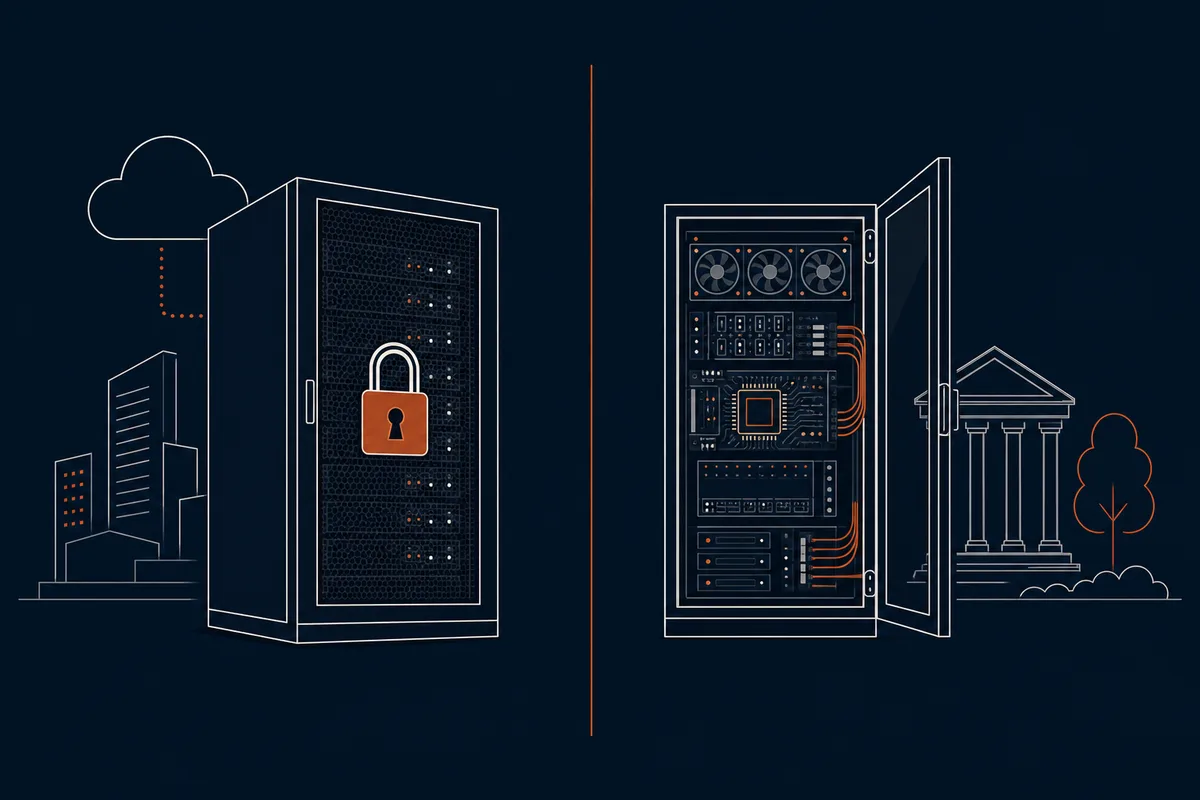
An open weight model running locally on your own hardware can't be taken from you by anyone. No vendor, no government, no export control. The model is on your own drive, running in your own environment, and it keeps working whether or not Washington sends a letter. That's not the most important argument for open source when you look at the technology. But when you look at continuity, it may be the most important argument there is.
Follow me on LinkedIn
Development three: the hardware became affordable
The strongest argument against open source was always practical. You need servers, GPUs, knowledge of model hosting. Running an open model locally sounded like something for companies with their own data centre and a team of engineers. For the average SME, that was a real barrier — and it's a fair objection.
That barrier is disappearing. NVIDIA released the DGX Spark (opens in new window), a device the size of a Mac Mini that NVIDIA itself calls "the world's smallest AI supercomputer". The Founders Edition costs around $4,000, with entry variants from partner manufacturers starting at around $3,000. For that money you get 128 GB of unified memory, enough to run models up to 200 billion parameters locally. Connect two of them and you're running models up to 405 billion parameters. That's the scale at which the largest open models run.
For comparison: a month of cloud GPU access for heavy development work easily costs $2,000 to $5,000. A device that costs $4,000 once and then lasts for years pays for itself within a few months under serious use. And it runs everything locally: no API costs, no latency from an external server, no data leaving your environment.
To be honest: it's not a miracle machine. Memory bandwidth is the bottleneck, it's not the fastest option for pure inference, and for a company without any technical capacity it's still not plug-and-play. But it fundamentally changes the calculation. Running locally is no longer a data centre project. It's a device on a shelf that costs less than two decent laptops. The last practical excuse to not investigate it has become considerably weaker.
Being honest about the counterarguments
I'd undermine my own credibility if I pretended open source is now problem-free. Three objections remain, and one of them arises from exactly the story I just told.
The government decision cuts both ways. Yes, a local model can't be taken from you. But that also means an open weight model that has been released can't be recalled if it turns out to be dangerous. It's on Hugging Face, downloaded thousands of times, and no government in the world can get it off the internet. That's precisely why regulators are wary of it. Sovereignty and uncontrollability are two sides of the same coin here. Whoever gains control over their own tools accepts that those same tools can no longer be corrected by anyone.
Technical capacity also remains necessary. The DGX Spark lowers the barrier, but doesn't remove it. Someone has to install, maintain, update and keep the model running. For an organisation with no technical role, that remains an investment — in people or in a partner.
And finally: not everything called "open source" actually is. Meta's Llama licence has commercial restrictions. DeepSeek hasn't fully published its training data. The Chinese origin of some models raises its own questions about data security and geopolitical dependency. You don't simply swap one dependency for total freedom. You swap it for another, one you can better steer yourself.
These nuances shouldn't be glossed over. But they don't change the main line. They only make it more mature.
Does it perform well enough?
The legitimate question underlying all of this: is open source qualitatively up to the mark? Because sovereignty and low costs are worth nothing if the model can't handle your question.
I've tested this myself. Not as a benchmark exercise, but because I wanted to know which model gives the best insurance advice — a domain I work with daily. Qwen 3.6 Plus (opens in new window), an open weight model from Alibaba, finished among the strongest. Free to run. In the specific domain I needed it for, it more than held its own against the proprietary alternatives I pay for.
This aligns with what the broader market has been showing for a long time. DeepSeek R1 performs at the level of OpenAI's o1 (opens in new window). Meta's Llama 3 in the 70-billion-parameter variant scores comparably to GPT-4, and the 405-billion variant outperforms it on several tasks. For most business applications — summarising documents, categorising customer emails, searching internal knowledge or writing reports — you don't need the very best frontier model at all. You need a model that's good enough for your question. And that level is well within reach with open source.
What this means for your strategy
If you take AI seriously as a board member, "open source vs. proprietary" was until recently a trade-off you could defer. That's no longer possible. Together, the three developments make it a question that belongs on the table now.
Four questions will help you. How dependent am I on a single vendor in a single jurisdiction, and what happens to my processes if that vendor raises its price, disconnects its model, or is forced by its own government to shut it down? Which of my AI applications process data or run processes too critical to hand over entirely? What are my actual costs over two years, if the current subsidised token price rises by 30 to 50 per cent? And do I have the technical capacity to run an alternative, or can I build or buy that capacity?
Nobody is saying you should cancel your OpenAI subscription tomorrow. For many tasks, a proprietary API remains the smartest choice: accessible, fast, and perfectly affordable at low volume. The right strategy is almost never black and white. It's a mix, in which you consciously choose which processes should sit on a sovereign, local foundation and which can comfortably run in a vendor's cloud.
But that choice must be conscious. Most organisations ended up with proprietary because it was the path of least resistance, not because they made the trade-off. That was justifiable when AI was new and cheap and nobody could shut down a model. That time is over.
Not a second choice, but an insurance policy
Open source AI was already an equally good and often cheaper choice even before this news. Now it's more. It's insurance against three risks that have all grown simultaneously: a cost structure you don't control yourself, a dependency that a government can terminate, and a barrier that was just high enough to justify deferring.
That barrier has been lowered. Costs are rising. And the government has shown it can pull the plug.
The question is no longer whether open source is good enough. That question has been answered. The question is whether your organisation can afford to leave full control of its critical tools in the hands of a party you don't know, in a country where you have no voice, at a price that still has to rise. That's not a technical choice. It's a governance one. And this month's news makes it more urgent than it has ever been.
Want to read more? I've also written about controlling AI costs, why OpenAI is increasingly becoming your competitor and the blind spot in the boardroom.